Carer’s Allowance UK 2026: Eligibility, Rates, and Support for Carers

Carer’s Allowance UK 2026: Eligibility, Rates, and Support for Carers
In the United Kingdom, unpaid carers form the backbone of our society, providing invaluable support to friends and family members who are ill, disabled, or elderly. This selfless dedication often comes at a personal cost, impacting their own financial stability and well-being. Recognising this, the government offers Carer’s Allowance, a vital benefit designed to provide some financial relief to those who dedicate a significant portion of their lives to caring for others. As we look ahead to 2026, understanding the specifics of Carer’s Allowance UK – including the weekly rate, eligibility criteria, and how to navigate the application process – becomes paramount for current and prospective carers.
The landscape of welfare benefits is subject to change, and staying informed about the latest updates is crucial. This comprehensive guide aims to demystify Carer’s Allowance for 2026, offering a detailed breakdown of what you need to know to ensure you or someone you know can access this essential support. We will delve into the intricacies of eligibility, the financial implications, and the broader support network available to carers across the UK.
What is Carer’s Allowance? Understanding the Core Benefit
Carer’s Allowance is the main welfare benefit for carers in the UK. It is paid by the Department for Work and Pensions (DWP) to individuals who spend a significant amount of time caring for someone with a disability. Unlike some other benefits, Carer’s Allowance is not means-tested based on savings or the income of the person you care for. However, there are strict rules regarding the carer’s own earnings, which we will explore in detail.
The primary purpose of Carer’s Allowance is to provide a modest income to carers who might otherwise struggle to balance their caring responsibilities with paid employment. It acknowledges the significant contribution carers make and aims to alleviate some of the financial pressures they face. While the amount may seem small compared to the immense value of the care provided, it can be a crucial lifeline for many households.
It’s important to differentiate Carer’s Allowance from other benefits. It is a non-contributory benefit, meaning eligibility doesn’t depend on National Insurance contributions. This makes it accessible to a wider range of carers, including those who may not have been in paid employment for an extended period due to their caring duties. Understanding its specific nature is the first step towards determining if you are eligible for this essential support.
The Carer’s Allowance UK Weekly Rate for 2026
For the financial year 2026-2027, it is anticipated that the Carer’s Allowance UK weekly rate will be around £76.70. This figure is based on the current rate of £76.70 per week for 2023-2024 and assumes no significant changes beyond standard inflationary adjustments or policy reviews. However, it is crucial to remember that benefit rates are subject to annual review by the government, usually announced in the Autumn Statement and confirmed in the spring. While this estimate provides a strong indication, always verify the most up-to-date figures closer to the time.
This weekly payment, while not a large sum, can significantly contribute to a carer’s household budget, helping to cover essential living costs. It is paid directly into a bank, building society, or Post Office account. Payments are typically made weekly in advance or every four weeks. Carers should choose the payment frequency that best suits their financial planning.
It’s also important to consider how Carer’s Allowance interacts with other benefits. Receiving Carer’s Allowance can sometimes increase entitlement to other means-tested benefits, such as Universal Credit, Housing Benefit, or Council Tax Reduction. This is because Carer’s Allowance is taken into account as income when calculating these benefits, but it also triggers a ‘carer element’ or ‘carer premium’ in some cases, which can lead to an overall increase in total benefit entitlement. This synergistic effect makes understanding the full scope of benefits vital for carers.
Key Eligibility Criteria for Carer’s Allowance UK in 2026
To be eligible for Carer’s Allowance in the UK for 2026, you must meet several stringent criteria. These rules are designed to ensure the benefit reaches those who genuinely provide substantial care. Let’s break down each requirement:
1. Care for Someone Receiving a Qualifying Disability Benefit
The person you care for must be receiving one of the following disability benefits:
- Personal Independence Payment (PIP) – daily living component (any rate)
- Disability Living Allowance (DLA) – middle or higher rate care component
- Attendance Allowance (any rate)
- Constant Attendance Allowance (at or above the normal maximum rate with an Industrial Injuries Disablement Benefit, or at the maximum rate with a War Disablement Pension)
- Armed Forces Independence Payment
Without the person you care for receiving one of these benefits, you cannot claim Carer’s Allowance. This is a non-negotiable prerequisite.
2. Provide at Least 35 Hours of Care Per Week
You must be providing care for at least 35 hours a week. This care does not necessarily have to be continuous or during specific hours of the day. It can include tasks such as:
- Helping with washing and dressing
- Cooking and preparing meals
- Managing medication
- Supervising the person for their safety
- Taking them to appointments
- Providing emotional support and companionship
The DWP will assess the nature and extent of the care you provide. It’s important to accurately detail all the support you offer when applying. You cannot combine hours of care for two different people to meet the 35-hour threshold; you must provide 35 hours of care to a single individual.
3. Your Earnings Must Be Below the Threshold
This is one of the most critical and often misunderstood eligibility criteria. For 2026, it is projected that your earnings, after deductions, must be no more than approximately £139 per week. This figure is based on the 2023-2024 earnings limit of £139 and is subject to annual review. If your earnings exceed this amount, even by a small margin, you will not be eligible for Carer’s Allowance.
When calculating your earnings, certain deductions are allowed:
- Income Tax and National Insurance contributions
- Half of any contributions towards an occupational or private pension
- Expenses incurred wholly, exclusively, and necessarily in carrying out your work (e.g., travel costs, specialist clothing)
- Costs of care for the person you care for (up to half your earnings)
- Costs of care for your own children (under 16) or other dependants while you’re at work (up to half your earnings)
It’s essential to keep meticulous records of your income and expenses to accurately calculate your earnings for the purpose of Carer’s Allowance. If your earnings fluctuate, you might need to average them over a period.
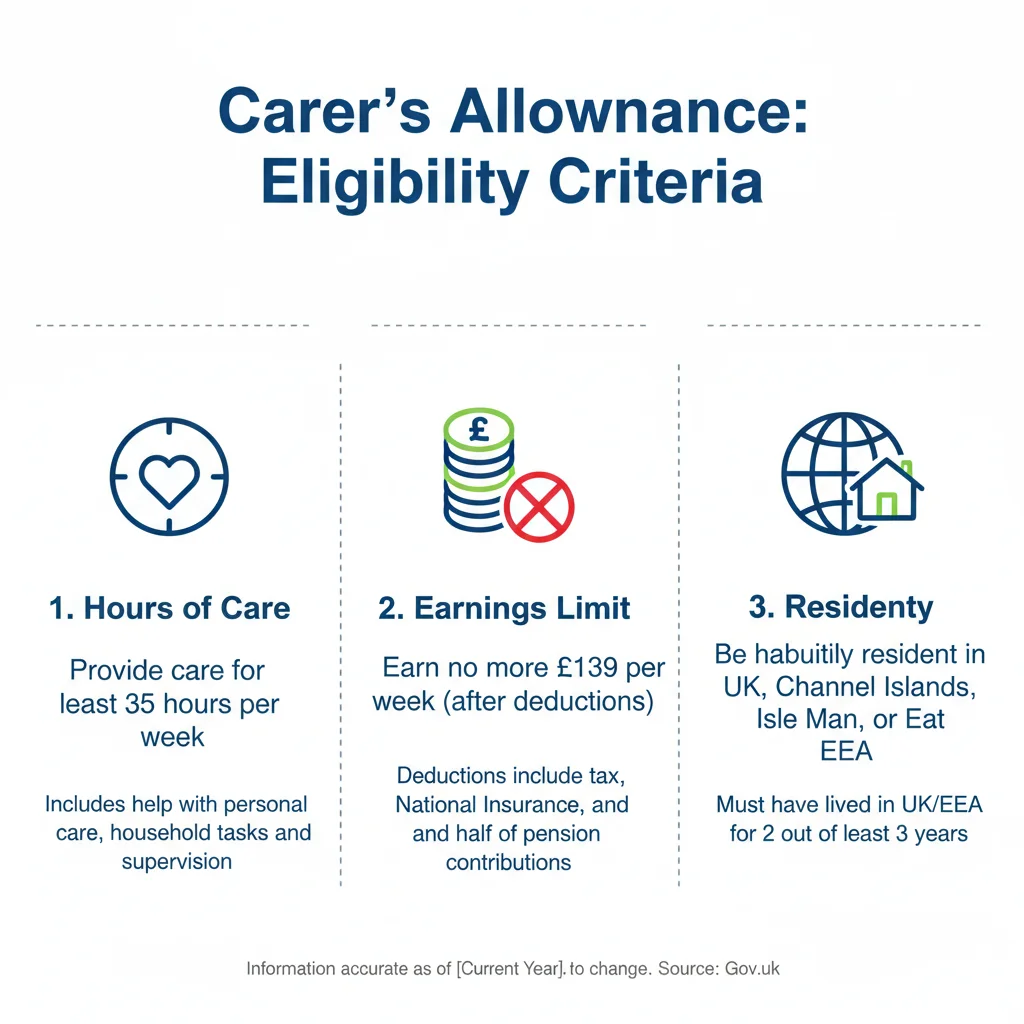
4. Age and Residency Requirements
- Age: You must be 16 years old or over.
- Residency: You must be habitually resident in Great Britain (this generally means you live in the UK and have lived here for a significant period, with some exceptions for EEA citizens or those with specific immigration statuses). There are also specific rules regarding periods spent abroad.
- Not in Full-Time Education: Generally, you cannot be in full-time education. Full-time education is typically defined as undertaking a course of study that involves 21 hours or more of classroom-based study per week.
Meeting all these criteria is essential for a successful Carer’s Allowance application. If you are unsure about any aspect, it is always advisable to seek guidance from official sources or welfare rights advisors.
How to Claim Carer’s Allowance in 2026
The process of claiming Carer’s Allowance can seem daunting, but by following the correct steps, it can be straightforward. Here’s a general guide to applying:
1. Gather Necessary Information
Before you begin your application, collect all the required information. This will include:
- Your National Insurance number
- The National Insurance number of the person you care for
- Details of the disability benefit the person you care for receives
- Your bank or building society details
- Details of your income, including any earnings from employment or self-employment, and any deductions (e.g., tax, National Insurance, pension contributions)
- Details of any other benefits you receive
- Information about your education (if applicable)
2. Apply Online or by Post
The most convenient way to apply for Carer’s Allowance is online via the GOV.UK website. The online application is generally faster and allows you to save your progress. Alternatively, you can request a claim form (DS700 for adults, or DS700A if you are claiming for a child) and submit it by post.
The online application guides you through each section, asking relevant questions about your caring responsibilities, income, and personal circumstances. Be as thorough and accurate as possible in your responses to avoid delays.
3. What Happens After You Apply?
Once your application is submitted, the DWP will review your information. They may contact you for further details or clarification. They will also likely contact the person you care for to confirm details about their disability benefit and the care they receive. This process can take several weeks, so patience is key.
If your claim is successful, you will receive a letter confirming your award and details of when payments will start. If your claim is unsuccessful, the letter will explain why. You have the right to challenge a decision you disagree with through a process called Mandatory Reconsideration, followed by an appeal to an independent tribunal if necessary.

Important Considerations for Carers
Beyond the direct payment, Carer’s Allowance can have several other implications for carers that are worth understanding:
Impact on Other Benefits
As mentioned, receiving Carer’s Allowance can affect other benefits you or the person you care for receive. Specifically:
- Universal Credit: If you receive Universal Credit, you will also get a ‘carer element’ added to your claim, which is a higher amount than the Carer’s Allowance itself. However, the Carer’s Allowance amount will be deducted from your total Universal Credit payment. It’s generally better to claim Carer’s Allowance first, as it can increase your overall Universal Credit entitlement.
- Income Support, Jobseeker’s Allowance, Employment and Support Allowance: Carer’s Allowance counts as income for these benefits. However, it can also trigger a ‘carer premium’ or ‘carer addition’ which might increase your overall entitlement.
- Pension Credit: Carer’s Allowance can lead to an increase in Pension Credit for eligible carers.
- The person you care for: If you claim Carer’s Allowance, the person you care for may lose their severe disability premium or extra amount for severe disability in their own benefits. It’s vital to check how this might affect their overall income, and it may be more beneficial for them not to lose this premium, especially if your Carer’s Allowance payment is less than the premium. Always do a benefit check for both parties before claiming.
National Insurance Credits
Receiving Carer’s Allowance also means you will automatically get National Insurance credits. These credits help to protect your future entitlement to the State Pension and certain other benefits, ensuring that gaps in your employment history due to caring responsibilities do not negatively impact your long-term financial security.
Breaks in Care
The DWP understands that carers sometimes need breaks. You can continue to receive Carer’s Allowance for up to 12 weeks in any 26-week period if you have a break from caring. This break can be for a holiday, illness, or other personal reasons. If the person you care for goes into hospital or a care home, your Carer’s Allowance may continue for up to 12 weeks after they enter care, as long as they still meet the disability benefit criteria. It’s crucial to inform the DWP about any changes in your caring situation.
Reporting Changes in Circumstances
It is your responsibility to report any changes in your circumstances to the DWP. This includes:
- Your earnings increasing above the threshold
- You stop providing 35 hours of care per week
- The person you care for no longer receives their qualifying disability benefit
- You start or stop full-time education
- You move address
- You go abroad for an extended period
Failure to report changes can lead to overpayments, which you will be required to pay back, and in some cases, penalties.
Additional Support for Carers in the UK
While Carer’s Allowance provides financial assistance, it is just one part of the support available to carers. Many other resources can help ease the burden of caring:
Carer’s Assessments
All carers have a right to a Carer’s Assessment from their local council (local authority). This assessment looks at the impact caring has on your life and identifies what support you might need. This could include:
- Practical help at home
- Respite care to give you a break
- Emotional support and counselling
- Information about other benefits or local services
- Training in caring skills
Even if you don’t receive Carer’s Allowance, you are still entitled to a Carer’s Assessment.
Local Carer Organisations
Across the UK, numerous local and national organisations offer support, advice, and a community for carers. Organisations like Carers UK, Carers Trust, and local carer centres provide invaluable services, including:
- Helplines and advice services
- Support groups
- Information on benefits and legal rights
- Advocacy services
- Training and workshops
- Respite activities
Connecting with these organisations can provide both practical assistance and a sense of community, reducing feelings of isolation that carers often experience.
Discounts and Concessions
Some carers may be eligible for discounts or concessions, such as a Carer’s Card, which can offer discounts at local businesses or help identify you as a carer to emergency services. It’s worth researching what is available in your local area.
The Future of Carer’s Allowance and Carer Support
The role of unpaid carers is increasingly recognised, and there are ongoing discussions about how best to support them. While the £76.70 weekly rate for Carer’s Allowance in 2026 provides a baseline, many advocate for a more substantial increase to truly reflect the economic value of the care provided and to lift carers out of poverty.
Policy debates often revolve around:
- Increasing the earnings limit: To allow carers to work more hours without losing their entitlement.
- Raising the weekly rate: To provide more meaningful financial support.
- Expanding eligibility: To include those caring for multiple individuals for fewer hours each, or those caring for people who don’t receive a qualifying benefit but still require significant care.
- Better integration with other benefits: To ensure carers receive maximum support without complex interactions between different benefits.
As we approach 2026, it is important for carers and their advocates to stay engaged with these discussions and continue to highlight the critical need for robust and fair support systems. The government’s commitment to carers will play a significant role in shaping the lives of millions across the UK.
Conclusion: Navigating Carer’s Allowance UK in 2026
Carer’s Allowance UK for 2026, with its anticipated weekly rate of £76.70, represents a crucial piece of the financial support puzzle for unpaid carers. Understanding its eligibility criteria – providing 35 hours of care, meeting earnings thresholds, and caring for someone on a qualifying benefit – is the first step towards accessing this vital assistance. The application process, whether online or by post, requires careful attention to detail, and a clear understanding of how Carer’s Allowance interacts with other benefits is paramount for maximising overall financial well-being.
Beyond the monetary aspect, carers should actively seek out the broader network of support available, including Carer’s Assessments and local carer organisations. These resources offer not only practical help and respite but also a sense of community and validation for the invaluable work that carers do. As the UK continues to grapple with an aging population and increasing demand for care, the role of unpaid carers will only grow in significance. Ensuring they are adequately supported, both financially and emotionally, is not just a matter of welfare but a societal imperative.
For anyone currently caring or considering taking on a caring role, staying informed about the latest policies and available support is essential. The information provided here aims to be a valuable resource as you navigate the complexities of Carer’s Allowance UK in 2026. Remember, you are not alone, and help is available.