
DLA to PIP Transition 2026: Your Essential Financial Guide
The landscape of disability benefits in the UK is undergoing a significant transformation, with the Disability Living Allowance (DLA) being steadily replaced by the Personal Independence Payment (PIP). For many, 2026 marks a crucial deadline as remaining DLA claimants are expected to transition to PIP. This change can bring uncertainty and anxiety, especially concerning financial implications and the application process. This comprehensive guide aims to demystify the DLA to PIP 2026 transition, providing you with the knowledge and tools to navigate this period effectively and ensure your financial well-being.
Understanding the nuances of this transition is not just about filling out forms; it’s about securing your future support. Whether you’re currently receiving DLA or assisting someone who is, this article will walk you through everything you need to know, from the fundamental differences between the two benefits to practical steps for a successful application and what to do if things don’t go as planned. Let’s embark on this journey together to ensure a smooth and informed transition.
Understanding the Shift: DLA vs. PIP
Before delving into the specifics of the DLA to PIP 2026 transition, it’s vital to grasp the core differences between Disability Living Allowance (DLA) and Personal Independence Payment (PIP). While both benefits aim to provide financial support to individuals with long-term health conditions or disabilities, their structures, eligibility criteria, and assessment processes differ significantly.
Disability Living Allowance (DLA)
DLA was a non-means-tested, tax-free benefit for people aged under 65 (at the time of claiming) who needed help with personal care or mobility due to an illness or disability. It was divided into two components:
- Care Component: Paid at three different rates (low, middle, high) depending on the level of personal care needed.
- Mobility Component: Paid at two different rates (low, high) depending on the level of mobility difficulties experienced.
One of DLA’s defining characteristics was that it was often awarded indefinitely, particularly for those with severe, lifelong conditions, and it generally did not require regular reassessments once awarded.
Personal Independence Payment (PIP)
PIP, introduced in 2013, is also a non-means-tested, tax-free benefit for people aged 16 and over (who haven’t reached State Pension age) who need help with daily living activities or getting around because of a long-term illness or disability. Like DLA, it has two components:
- Daily Living Component: Paid at two rates (standard, enhanced) based on how a condition affects your ability to carry out daily tasks.
- Mobility Component: Paid at two rates (standard, enhanced) based on how a condition affects your ability to get around.
The key distinction with PIP lies in its assessment process. It focuses on how an individual’s condition affects their ability to perform specific daily living and mobility activities, using a points-based system. Most claimants will undergo a face-to-face assessment (or a telephone/video assessment) with an independent healthcare professional, and awards are typically for a fixed period, requiring periodic reviews.
Why the Change?
The government introduced PIP to replace DLA for working-age adults (initially 16-64) with the stated aim of creating a fairer, more consistent, and sustainable benefit that better reflects today’s understanding of disability. While this objective is laudable, the transition has been a source of significant concern for many, as the stricter assessment criteria and focus on ‘how’ a disability affects daily life, rather than just the diagnosis, have led to some DLA recipients losing their entitlement or receiving a lower award under PIP.
Who Will Be Affected by the 2026 Deadline?
The transition from DLA to PIP has been ongoing for several years, with various groups being invited to claim PIP at different stages. The DLA to PIP 2026 deadline primarily concerns those DLA recipients who have not yet been invited to claim PIP. This largely includes:
- Existing DLA claimants aged 16 or over who were receiving DLA when PIP was introduced in 2013, and who have not yet been reassessed for PIP.
- Those who were under 16 when PIP was introduced and are still receiving DLA, who will be invited to claim PIP when they turn 16.
It’s important to note that children under 16 will continue to claim DLA. Once they turn 16, they will then be invited to apply for PIP. Individuals who are already receiving PIP, or who successfully transitioned from DLA to PIP previously, will not be affected by this specific 2026 deadline, though their PIP awards will be subject to regular reviews.
What to Expect: The Invitation Process
If you are an eligible DLA claimant, you will eventually receive a letter from the Department for Work and Pensions (DWP) inviting you to apply for PIP. This letter is crucial and will outline the steps you need to take. Do not ignore this letter. It will specify a deadline by which you must apply for PIP, usually within a few weeks. If you fail to respond or apply by the deadline, your DLA payments will stop.
The DWP manages the transition in phases, so not everyone will receive their invitation at the same time. While 2026 is a general target, invitations will continue to be sent out in the preceding years. It’s advisable to stay informed and prepare in advance, even if you haven’t received your letter yet.
The PIP Application Process: A Step-by-Step Guide
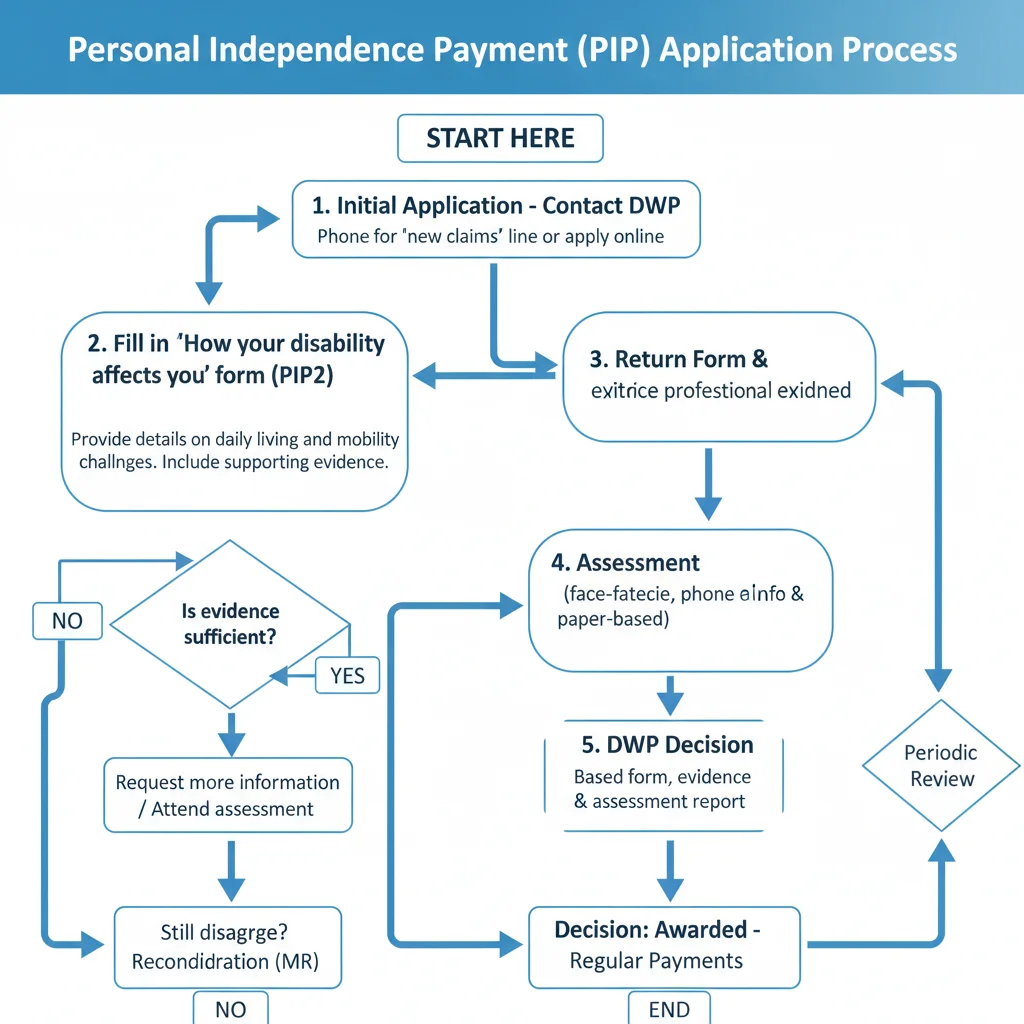
The PIP application can seem daunting, but breaking it down into manageable steps can make it less overwhelming. Here’s a detailed guide to the process, crucial for a successful DLA to PIP 2026 transition:
Step 1: Starting Your Claim
Once you receive your invitation letter, the first step is to contact the DWP to start your claim. You’ll usually do this by phone. During this call, you’ll be asked for some basic information, and the DWP will then send you the ‘How your disability affects you’ form (also known as the PIP2 form).
Key Tip: Keep a record of the date you called, who you spoke to, and any advice given. This can be useful if there are any discrepancies later.
Step 2: Completing the ‘How your disability affects you’ Form (PIP2)
This is arguably the most critical part of the application. The PIP2 form asks detailed questions about how your condition affects your daily living and mobility. It’s not about your diagnosis, but about the impact of your condition on your ability to perform specific tasks. Be thorough, honest, and provide as much detail as possible.
- Describe your difficulties: For each question, explain what difficulties you face, how often, and how long they take.
- Be specific: Instead of saying ‘I have difficulty walking,’ explain ‘I can walk about 20 metres slowly and with severe pain before needing to stop and rest for 15 minutes due to chronic back pain.’
- Think about ‘reliably’: Can you do tasks safely, to an acceptable standard, repeatedly, and in a reasonable time? If not, explain why.
- Consider fluctuating conditions: If your condition varies, describe what it’s like on your worst days, as well as your average days.
- Don’t minimise your difficulties: It’s common for people to downplay their struggles. Be realistic about the help you need.
You will have a deadline (usually one month) to return this form. If you need more time, contact the DWP immediately to request an extension.
Step 3: Gathering Supporting Evidence
Alongside your PIP2 form, strong supporting evidence is crucial. This can include:
- Medical reports: From your GP, specialists, physiotherapists, occupational therapists, etc.
- Prescription lists: Showing your medications.
- Care plans: From social services or other care providers.
- Letters from support workers or carers: Detailing the help you receive.
- Diaries: Documenting your daily difficulties over a period.
Make sure any evidence you submit is recent and directly relevant to how your condition affects you. If you don’t have recent evidence, consider asking your GP or specialist for an updated letter detailing your current functional limitations.
Step 4: The PIP Assessment
Most applicants will need to attend an assessment with an independent healthcare professional. This could be face-to-face, over the phone, or via video call. The assessor will ask questions about your daily life and how your condition affects you. They may also observe how you perform certain tasks or move.
- Prepare: Re-read your PIP2 form and your supporting evidence before the assessment.
- Be honest: Don’t exaggerate, but don’t downplay your difficulties either.
- Take someone with you: A friend, family member, or support worker can provide emotional support and help you remember details.
- Explain the impact: Continually link your condition to how it affects your ability to do tasks.
The assessor will then write a report and send it to the DWP. You can request a copy of this report once the DWP has received it.
Step 5: The DWP Decision
After reviewing your PIP2 form, supporting evidence, and the assessment report, the DWP will make a decision on your claim. They will send you a letter explaining their decision, including whether you’ve been awarded PIP, at what rate (standard or enhanced for each component), and for how long. This letter is often called a ‘decision letter’ or ‘award letter’.
Maximising Your PIP Award: Financial Considerations
A successful DLA to PIP 2026 transition is not just about getting an award; it’s about getting the correct award that reflects your needs. PIP rates are set amounts, but the level of financial support you receive depends entirely on the points you score in your assessment.
Understanding the Points System
PIP uses a points-based system across 10 daily living activities and 2 mobility activities. For each activity, there are descriptors, and you score points based on which descriptor best applies to you. You need 8 points for the standard rate and 12 points for the enhanced rate of each component.
Impact on Other Benefits and Entitlements
Being awarded PIP can open doors to other financial support and entitlements. These ‘passporting’ benefits are a crucial aspect of your financial planning during the DLA to PIP 2026 transition:
- Increased Income-Related Benefits: An award of PIP, particularly the daily living component, can lead to increased amounts in benefits like Universal Credit, Housing Benefit, and Pension Credit.
- Carer’s Allowance: If someone provides significant care for you, your PIP award (daily living component) can enable them to claim Carer’s Allowance.
- Blue Badge Scheme: The mobility component of PIP can help you qualify for a Blue Badge, offering parking concessions.
- Vehicle Tax Exemption: The enhanced rate of the mobility component can entitle you to a full exemption from vehicle tax.
- Motability Scheme: The enhanced rate of the mobility component can allow you to lease a car, scooter, or powered wheelchair through the Motability Scheme.
- Council Tax Reduction: Depending on your local council, PIP can affect your eligibility for council tax reductions.
- Free Prescriptions: In some cases, depending on other benefits you receive alongside PIP, you might be entitled to free prescriptions.
It’s vital to inform other benefit providers (e.g., your local council for Housing Benefit/Council Tax Reduction, or Universal Credit) about your PIP award, as it could increase your entitlements. Make sure to check what other support you might be eligible for.

What if Your PIP Claim is Denied or You Disagree with the Decision?
It’s not uncommon for initial PIP claims to be denied or for claimants to receive a lower award than they believe they are entitled to. If this happens during your DLA to PIP 2026 transition, don’t despair. There’s a robust appeals process:
Step 1: Mandatory Reconsideration
If you disagree with the DWP’s decision, you must first request a ‘Mandatory Reconsideration’ (MR). You usually have one month from the date of your decision letter to do this. You can do this by phone or by writing to the DWP. It’s highly recommended to do it in writing, clearly stating why you believe the decision is wrong and providing any additional evidence you may have.
The DWP will then review your claim again, and a different decision-maker will look at all the evidence. They will send you a ‘Mandatory Reconsideration Notice’ explaining their revised decision.
Step 2: Appeal to an Independent Tribunal
If you still disagree after the Mandatory Reconsideration, you can appeal to an independent tribunal. You usually have one month from the date of your Mandatory Reconsideration Notice to do this. This appeal is made to HM Courts & Tribunals Service, not the DWP.
An independent judge and a medically qualified member will hear your case. This is often a more successful stage for claimants, as tribunals tend to take a fresh look at the evidence and often ask more probing questions about the impact of your condition. Many people find success at this stage, so it’s a critical option to pursue if you believe your initial assessment was incorrect.
Seeking Advice
Throughout this process, seeking advice from welfare rights organisations like Citizens Advice, Scope, or Disability Rights UK can be invaluable. They can help you understand the criteria, complete forms, gather evidence, and represent you at tribunals.
Preparing for the DLA to PIP 2026 Transition: A Checklist
Proactive preparation is key to a smooth DLA to PIP 2026 transition. Here’s a checklist to help you get ready:
- Understand PIP criteria: Familiarise yourself with the PIP daily living and mobility activities and how points are awarded.
- Gather medical evidence: Start collecting recent medical reports, diagnoses, prescription lists, and any other documents that describe your condition and its impact.
- Keep a diary: For a few weeks, make notes about your daily difficulties, including how long tasks take, if you need help, and how your condition fluctuates.
- Identify support: Think about who helps you with daily tasks and if they would be willing to write a letter of support.
- Seek advice: Contact a welfare rights organisation for guidance on what to expect and how to prepare your application.
- Inform others: If you have a carer or receive other benefits, make sure they are aware of the upcoming transition.
- Budgeting: Be aware that your DLA payments will stop once you start a PIP claim, and it can take time for a decision to be made. Plan your finances accordingly.
- Stay organised: Keep all correspondence from the DWP and copies of your application forms and evidence in a dedicated folder.
Common Mistakes to Avoid During Your PIP Application
Navigating the DLA to PIP 2026 transition effectively means being aware of common pitfalls. Avoiding these can significantly improve your chances of a successful claim:
- Understating your difficulties: Many individuals, especially those who have lived with their condition for a long time, tend to minimise the challenges they face. Be brutally honest about your worst days and the full extent of your needs.
- Focusing on diagnosis, not impact: The DWP is interested in ‘how’ your condition affects you, not just ‘what’ your diagnosis is. Explain the functional limitations in detail.
- Lack of specific examples: General statements like ‘I get tired easily’ are less effective than ‘Due to chronic fatigue, I can only concentrate on a task for 15 minutes before needing to rest for an hour, making it impossible to cook a meal unaided.’
- Insufficient evidence: A strong claim is backed by robust, recent medical and non-medical evidence. Don’t rely solely on your word.
- Missing deadlines: The DWP operates on strict deadlines. Missing these can lead to your claim being closed or DLA payments stopping. Always communicate if you need an extension.
- Not preparing for the assessment: Go into your assessment informed and ready to articulate your needs clearly. Bring notes if it helps.
- Giving up after initial rejection: Many successful PIP awards are achieved after Mandatory Reconsideration or at the tribunal stage. Don’t be deterred by an initial negative decision.
- Not seeking advice: Expert advice from welfare rights organisations can make a profound difference to your application’s success.
The Future Beyond 2026: What to Expect
While 2026 marks a significant milestone for the DLA to PIP 2026 transition, it’s important to remember that disability benefits are subject to ongoing review and policy changes. Once you are on PIP, your award will typically be for a fixed period (e.g., 2, 3, 5, or 10 years), after which you will be invited for a review. This involves completing a shorter review form and potentially another assessment.
Staying informed about government announcements and benefit reforms is always recommended. Organisations like Disability Rights UK and Citizens Advice regularly update their resources to reflect the latest changes. Maintaining good records of your health condition and how it affects you will continue to be important for any future reviews or claims.
Conclusion
The transition from DLA to PIP is a significant event for thousands of individuals across the UK. While it presents challenges, being well-informed and prepared can make a substantial difference to the outcome of your claim. This guide has provided a comprehensive overview of the process, from understanding the differences between DLA and PIP to navigating the application, assessment, and appeals stages.
Remember, the goal is to articulate your needs clearly and accurately, supported by strong evidence. Don’t hesitate to seek professional advice from welfare rights experts, as their guidance can be invaluable. By taking proactive steps and understanding each stage of the DLA to PIP 2026 transition, you can help ensure that you continue to receive the financial support you are entitled to, allowing you to live as independently and comfortably as possible.
Your well-being is paramount, and navigating this transition successfully is a crucial step in maintaining your financial security and quality of life. Start preparing today, and empower yourself with the knowledge to make this transition as smooth as possible.