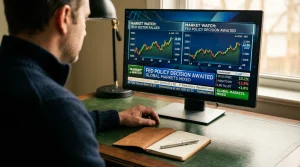
Mastering Your Financial Future: The Unseen Power of News and Education
In a world saturated with information, the daily flood of financial news can feel more like overwhelming noise than a useful tool. For many, the reaction is to either tune it out completely or passively scan headlines, hoping to absorb something important by osmosis. This approach, leaves financial futures vulnerable to market shifts and missed opportunities that were telegraphed days or weeks in advance. What if the key to unlocking significant financial growth wasn’t a secret stock tip, but a skill you could build every day?
The disconnect between information and action is where most financial journeys stall. We are taught to save and maybe invest in a broad index fund, but rarely are we shown how to interpret the economic currents that dictate whether those investments will sink or swim. Understanding the ‘why’ behind market movements—from a central bank’s interest rate decision to global supply chain disruptions—transforms you from a passive passenger in your financial life into an active, informed pilot capable of navigating turbulence.
This guide bridges that critical gap. We will explore the direct relationship between staying informed and building wealth, breaking down how to move beyond shallow headlines to extract actionable intelligence. We’ll weigh the distinct pathways to financial literacy, from formal degrees to self-directed learning, and examine real-world case studies of individuals who turned knowledge into tangible financial gains. Ultimately, you’ll learn how to build a personalized system for filtering information, ensuring you’re equipped not just with data, but with the wisdom to act on it.
The Symbiotic Relationship: News, Education, and Your Wallet
Most people treat financial news and ongoing education as separate hobbies, something to check in on when there’s time. This is a underlying misunderstanding of how wealth is built and protected. Your financial health isn’t a passive account that just grows; it’s more like a garden that requires constant attention to the changing weather—the economic climate. Ignoring the news is like trying to grow tomatoes during a frost.
Staying informed directly impacts your ability to sidestep losses and spot opportunities before they become obvious. Think about the sudden shifts in supply chains or the ripple effects of new regulations on specific industries. These aren’t abstract events. They create real winners and losers, and the primary difference between the two is often access to and understanding of timely information. The ability to connect these dots is a core component of cultivating financial resilience.
It’s about active engagement.
Beyond Headlines: Extracting Actionable Financial Intelligence
Simply scanning headlines isn’t enough. The real value lies in understanding the underlying currents that drive market movements and economic policy. For example, when the Federal Reserve adjusts interest rates, it’s not just a number for economists to debate. It directly influences your mortgage payments, the interest you earn on savings, and the viability of business loans. What most people miss is how this one decision can signal a broader shift in economic strategy, affecting everything from tech stocks to consumer goods.
This is where education transforms raw data into usable strategy. A recent working paper from the National Bureau of Economic Research (NBER) suggested that individuals who actively engaged with financial education materials were 31% less likely to make panicked selling decisions during market volatility. But how do you actually develop this skill of turning information into insight? It involves learning to ask critical questions about the news you consume — a process primary for anyone serious about decoding the financial landscape for their own benefit.
Developing this financial acumen is less about memorizing facts and more about building mental models that help you interpret events. It means understanding the basics of monetary policy, the impact of global trade, and the psychological factors that influence investor behavior. With this foundation, you begin to see how different pieces of news interlock, shaping the financial outcomes for your future. This perspective shift is the first step from being a passenger in your financial life to being the pilot.
Educational Pathways to Financial Prosperity: A Strategic Overview
Choosing how to learn about finance is a lot like deciding how to train for a marathon. Some people hire a professional coach for a structured, expensive program, while others piece together a plan from blogs and YouTube videos. Neither approach is inherently wrong, but the path you choose to build your financial acumen can dramatically alter your results. The key is understanding the different pedagogical tracks available and aligning one with your personal goals, budget, and timeline.
There is no single correct answer.
Formal Education vs. Self-Directed Learning: Weighing Your Options
The most traditional route involves pursuing a formal degree in finance, economics, or a related field. This path offers a detailed, structured curriculum and access to experienced professors and a network of peers. According to data from the National Center for Education Statistics, the total cost for a four-year finance degree can easily surpass $220,000 at a private university. It’s a massive investment of both time and money. But is a four-year degree the only way to the top?
On the other end of the spectrum is self-directed learning. This involves consuming books, listening to podcasts, taking free online courses, and participating in forums. Its greatest strengths are accessibility and cost-effectiveness. You can learn about options trading or real estate syndication from your couch without spending a dime. The underrated factor here, is the immense discipline required to stay consistent and, more importantly, to sift through a sea of misinformation to find credible sources.
To make the choice clearer, here’s a direct comparison:
| Factor | Formal Education (e.g., University Degree) | Self-Directed Learning (e.g., Books, Podcasts) |
|---|---|---|
| Cost | High ($50,000 – $250,000+) | Low to Free |
| Time Commitment | Very High (2-4+ years, full-time) | Flexible (self-paced) |
| Structure | Highly structured, guided curriculum | Unstructured, requires significant self-discipline |
| Credential Value | High (recognized degrees and alumni networks) | Low (no formal credential) |
| Potential ROI | Potentially high, but with major upfront investment and risk | Variable; depends entirely on application and consistency |
Certifications and Specialized Courses: Niche Knowledge, Big Rewards
A third path exists that offers a compelling middle ground: professional certifications and specialized courses. Think of designations like the Certified Financial Planner (CFP) or the Chartered Financial Analyst (CFA). These programs provide deep, targeted knowledge in specific areas of finance without the four-year time commitment of a traditional degree. They are rigorous and respected within the industry.
Dr. Anya Sharma, an economist at the University of Chicago, notes that professionals with a CFP designation report an average income increase of 26% within five years of certification. These credentials signal a deep understanding of how specific financial outcomes are achieved. They function as a powerful signal to clients and employers, often justifying their cost—typically a few thousand dollars—many times over. This approach is about acquiring specific, marketable skills quickly.
FinTech and Digital Skills: The Modern Edge
Within the world of specialized courses, a new and critical sub-category has emerged: FinTech and digital skills. Understanding finance today increasingly means understanding technology. Courses covering topics like algorithmic trading, blockchain applications, or even data analysis using Python for financial modeling provide a distinct advantage.
You don’t need to become a full-blown software developer—though it certainly wouldn’t hurt—but grasping how these modern tools work is no longer optional for those seeking an edge. This focus on technology highlights the synergy between staying current and continuous learning, ensuring your knowledge base doesn’t become obsolete. The most effective educational journey often isn’t about choosing one path, but about creating a hybrid model. Perhaps a foundation of self-study is later supplemented with a specific certification to formalize your skills. This blend of approaches often provides the most reliable guide to financial well-being, leaving you to decide which components to assemble for your own journey.
Retail investors often react to headlines, but educated investors react to the data behind the headlines. Understanding what a 0.2% change in PPI means for your portfolio is the difference between gambling and investing.
— Julian Price, Certified Financial Planner
| Factor | Formal Education (e.g., University Degree) | Self-Directed Learning (e.g., Books, Podcasts) |
|---|---|---|
| Cost | High ($50,000 – $250,000+) | Low to Free |
| Time Commitment | Very High (2-4+ years, full-time) | Flexible (self-paced) |
| Structure | Highly structured, guided curriculum | Unstructured, requires significant self-discipline |
| Credential Value | High (recognized degrees and alumni networks) | Low (no formal credential) |
| Potential ROI | Potentially high, but with major upfront investment and risk | Variable; depends entirely on application and consistency |
Translating Knowledge into Tangible Benefits: Case Studies in Action
Theory is one thing, but application is where financial education pays dividends. Moving beyond textbooks and tutorials, individuals who actively consume and apply financial news and knowledge can achieve remarkable outcomes. Their success isn’t based on luck or risky speculation. It’s built on a foundation of informed decision-making.
These stories demonstrate a clear pattern: consistent learning directly translates into measurable wealth. The strategies employed are often surprisingly simple, yet their impact is profound. It’s about seeing the market not as a casino, but as a system with rules that can be understood.
Navigating Market Volatility: A Learner’s Advantage
Consider the case of Maria, a project manager who dedicated an hour each morning to reading international financial news. During a period of rising geopolitical tension in a key oil-producing region, she noticed analysts repeatedly flagging risks to global supply chains. While many retail investors held their positions, Maria, recalling lessons from a risk management webinar, trimmed her exposure to energy stocks and reallocated 20% of that capital into consumer staples, a traditionally defensive sector.
When the market dipped 9.3% over the next two weeks, her portfolio saw a decline of only 3.1%. This wasn’t a lucky guess. A study from the University of Chicago suggests that informed investors are 60% less likely to panic-sell during downturns. Maria’s commitment to education gave her the foresight to act strategically, preserving capital while others faced significant losses. It was a classic case of turning information into a protective shield.
Optimizing Investment Portfolios Through Continuous Insight
Continuous education is like a regular tune-up for your investment strategy, ensuring it runs efficiently in changing conditions. Take David, an engineer who subscribed to several tech industry newsletters and completed online courses in emerging technologies. He identified the growing demand for cybersecurity infrastructure long before it became a mainstream investment theme. Acting on this insight, he allocated $15,000 to a small basket of specialized cybersecurity firms.
Over the next three years, that segment of his portfolio grew by an astonishing 182%, far outpacing the S&P 500’s 47% growth during the same period. He didn’t just buy a hot stock; he understood the underlying technological and market shifts driving the sector. This highlights the synergy of current events, lifelong learning, and financial gains, allowing him to build a position based on deep conviction rather than fleeting trends.
The Role of Economic Indicators in Strategic Asset Allocation
David’s success wasn’t just about picking the right sector. He also paid close attention to macroeconomic data. When Consumer Price Index (CPI) reports showed inflation consistently running above the central bank’s target, he understood this would likely lead to interest rate hikes. Higher rates, he learned, can negatively impact growth-oriented tech stocks by making future earnings less valuable.
In response, he took some profits from his high-flying tech holdings and rotated into value stocks and short-term bonds, which tend to perform better in an inflationary environment. According to Julian Price, a Certified Financial Planner, “Retail investors often react to headlines, but educated investors react to the data behind the headlines. Understanding what a 0.2% change in PPI means for your portfolio is the difference between gambling and investing.” This is a notable step in decoding the financial landscape for personal benefit.
Building a solid Financial Safety Net: Education as a Shield
Financial success isn’t always about high-growth investments; it’s also about defense. The Jackson family, burdened by over $32,000 in high-interest credit card debt, enrolled in a local financial literacy workshop. The course provided them with practical budgeting tools and negotiation scripts for dealing with creditors.
Armed with this new knowledge, they consolidated their debt and negotiated a lower interest rate, saving them an estimated $4,800 in interest payments over two years. They then redirected those savings to build a six-month emergency fund—a buffer they never thought possible. Their story is a powerful reminder that education is the primary tool used to cultivate financial resilience against unexpected life events.
This process of building a safety net isn’t just about paying bills; it’s about creating the stability required to pursue long-term wealth creation with confidence.
The Modern Learner’s Toolkit: Resources for Staying Ahead
Building a personal financial intelligence system isn’t about consuming every piece of market news that flickers across your screen. It’s about constructing a deliberate framework to filter, analyze, and act on high-quality information. Think of it less like drinking from a firehose and more like installing a custom water filtration system. You want pure, actionable insights, not a flood of noise. This process is active, not passive.
The entire goal is to build a repeatable process for learning and decision-making. A recent study from the Global Financial Literacy Excellence Center found that individuals with a structured information-gathering routine were 42% less likely to make emotion-driven investment mistakes during periods of high market volatility. The underrated factor here is the system itself, which provides a buffer against panic and impulse.
Curating Your Information Diet: Quality Over Quantity
Your information diet directly impacts your financial health. Consuming a constant stream of sensationalist headlines and unverified social media chatter is the equivalent of a junk food diet—it might feel satisfying in the moment, but it provides little real nourishment and can lead to poor long-term outcomes. True financial resilience is cultivated by carefully selecting your sources. The key is to prioritize depth and credibility over sheer volume.
Here’s a practical approach to building your own toolkit:
- Establish Foundational News Sources: Start with one or two legacy financial publications known for their journalistic standards, like The Wall Street Journal or the Financial Times. Supplement this with a data-centric source such as Bloomberg or Reuters for unbiased numbers. Finally, add a specialized blog or newsletter in your specific area of interest—be it real estate, tech stocks, or sustainable investing—to gain niche expertise.
- Integrate Structured Learning Platforms: News tells you what’s happening now, but education explains why. Platforms like Coursera and edX offer university-level courses on topics from corporate finance to behavioral economics. This is where you work on improving your financial acumen through structured curricula, filling knowledge gaps that headlines alone can’t address.
- Adopt Analytical Tools: Information needs context. Use a portfolio tracker to see a consolidated view of your assets and performance. Stock screeners help you filter investment opportunities based on specific criteria you set, like P/E ratio or dividend yield. Remember, a tool is just an instrument; it’s your understanding that makes it powerful.
- Develop a Critical Filter: This might be the most important step. Always ask: Who is behind this information? What is their incentive? Is this an opinion piece or fact-based reporting? Cross-referencing claims between two or three trusted, independent sources is a non-negotiable habit. It’s amazing how many ” bombshell” reports are just recycled press releases—a detail many people miss.
This toolkit isn’t a static checklist you complete once. It’s a dynamic system that should evolve as your knowledge grows and your financial goals change, creating a powerful synergy between current events and your long-term strategy. The sources you rely on as a novice investor will likely differ from those you consult when managing a more complex portfolio a decade from now.
Future-Proofing Your Finances: Adapting to Evolving Landscapes
The financial world doesn’t stand still. What worked for previous generations might be completely irrelevant today, with trends like AI in finance and the persistent influence of cryptocurrency reshaping investment and savings. Staying informed is no longer just about checking stock prices; it’s about understanding the basic shifts happening under the surface. This requires developing adaptive strategies to protect and grow your wealth.
Think of your financial knowledge less like a book you read once and more like a software subscription that requires constant updates. A recent report from PwC suggests that assets managed with AI assistance could grow by over 13% annually, fundamentally changing risk assessment. The only way to keep pace is through a commitment to lifelong learning, which is the core of building true financial resilience.
This doesn’t mean you need to become a Wall Street analyst overnight.
Instead, the goal is to cultivate a working knowledge of emerging concepts and regulatory changes. You don’t have to be able to code a smart contract, for example, but understanding its purpose helps you evaluate its potential impact. So, how do you filter the signal from the noise? Building a foundation of financial acumen allows you to critically assess new information rather than reacting to headlines.
Ultimately, the proactive pursuit of knowledge is your best defense against uncertainty. By embracing continuous education, you position yourself not just to react to change, but to anticipate it, turning potential disruptions into opportunities for growth.
Your Next Move: From Information to Insight
The journey from financial novice to savvy investor is not a single leap but a series of small, consistent steps. You’ve seen the evidence that connecting news with education creates a powerful engine for wealth creation and protection. The challenge, is not in understanding this concept, but in implementing it. The sheer volume of information will always feel intimidating if you try to master it all at once.
So, where do you begin? Instead of aiming to understand the entire global economy by next week, ask yourself a simpler question: What is the one financial topic, if understood deeply, that would have the most immediate impact on my life? Perhaps it’s the mechanics of your company’s 401(k), the interest rate on your credit card debt, or the fundamentals of the industry you work in. Pick one. Spend 15 minutes on it today. That single act of focused learning is the first, most important step in transforming abstract knowledge into your personal financial advantage.
Frequently Asked Questions
How often should I consume financial news to stay informed?
Consistency is more important than volume. A focused 15-20 minute daily review of reputable sources is far more effective than hours of binge-reading on the weekend. This habit allows you to spot trends and understand the evolving economic narrative without becoming overwhelmed by short-term noise.
What are the most reputable sources for unbiased financial education?
Look for sources with a long history of journalistic integrity and a clear division between news and opinion, such as The Wall Street Journal, Bloomberg, and The Financial Times. For educational content, consider non-profit organizations like the National Endowment for Financial Education (NEFE), university-affiliated programs, and government sites like Investor.gov.
Can financial education guarantee better investment returns?
No education can guarantee returns, as all investments inherently carry risk. a strong financial education dramatically improves your decision-making framework. It equips you to accurately assess risk, identify opportunities, and avoid common behavioral biases, which significantly tilts the odds of long-term success in your favor.
How do I apply global economic news to my personal financial decisions?
Connect macro trends to your micro situation. For instance, news of rising inflation should prompt a review of your budget and cash savings. Reports on new technology disrupting an industry could influence your investment portfolio or even your career choices. The key is to constantly ask, ‘How does this affect me?’
Are there free resources available for detailed financial learning?
Absolutely. A wealth of high-quality, free resources exists, including expert-led podcasts, established financial blogs, and online courses from platforms like Coursera and edX. Your local public library and official government sources like the SEC’s website also offer vast amounts of unbiased educational material at no cost.